Electrifying Ambulances
Performance and cost comparison of 18650 lithium-ion cells accessible to Ghana for electric vehicle applications

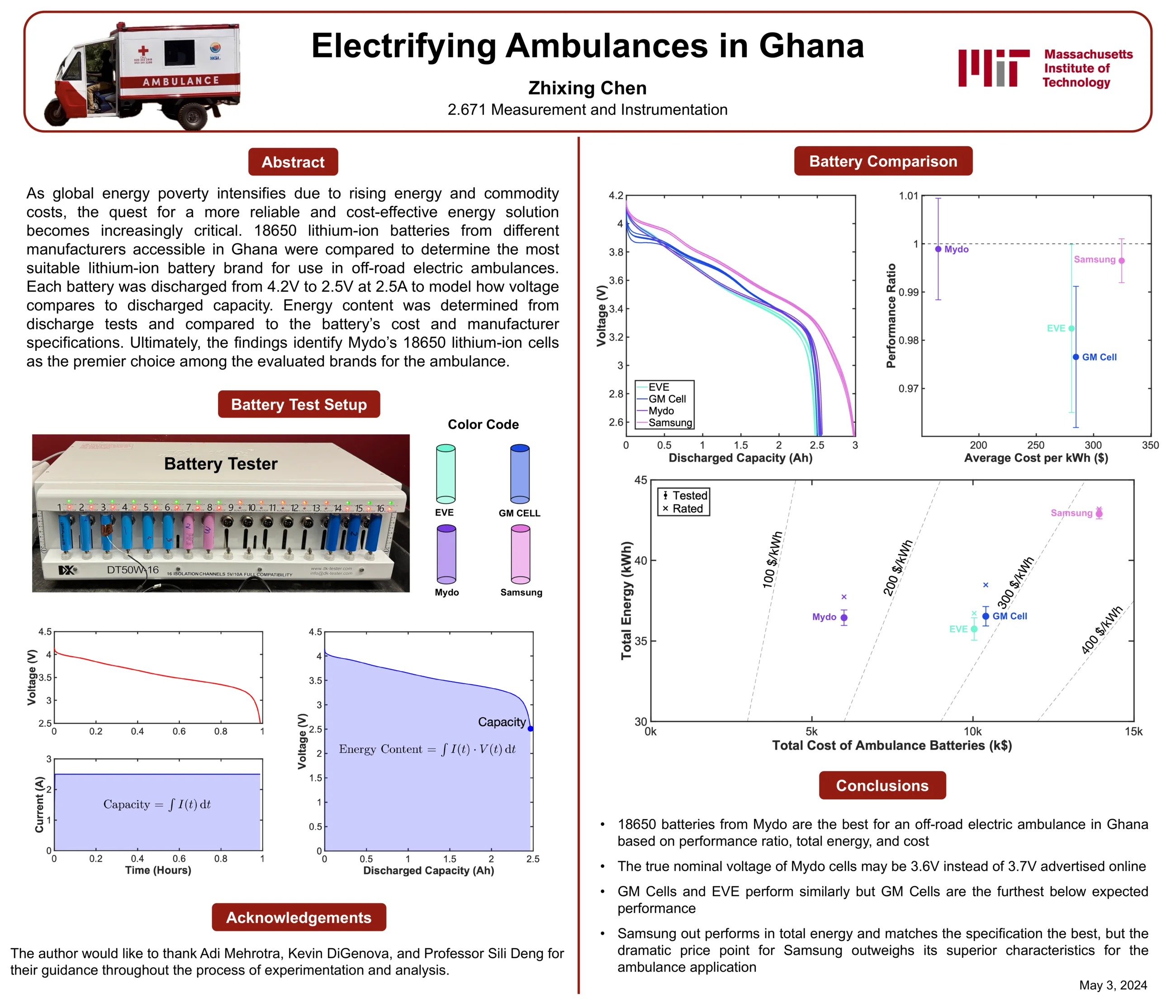
Continued work with Moving Health, after the Off-Road Ambulance, focuses on electrifying the vehicles. If off-road ambulances can adopt electric power, they can ensure a more steady, reliable service. This was my own final project for 2.671 Measurement and Instrumentation at MIT: choosing the cells for that battery, supervised by Adi Mehrotra of the MIT Precision Engineering Research Group under Prof. Alexander Slocum.
Battery cell selection is crucial to the overall performance, longevity, and affordability of electric vehicles, and which cells you can get depends on where you are. In Ghana, select brands of 18650 lithium-ion batteries are available, each with unique attributes and costs: EVE, GM Cell, Mydo, and Samsung. I compared their capacity, energy content, performance ratio and cost to find the most suitable cell for an off-road electric ambulance.
Method
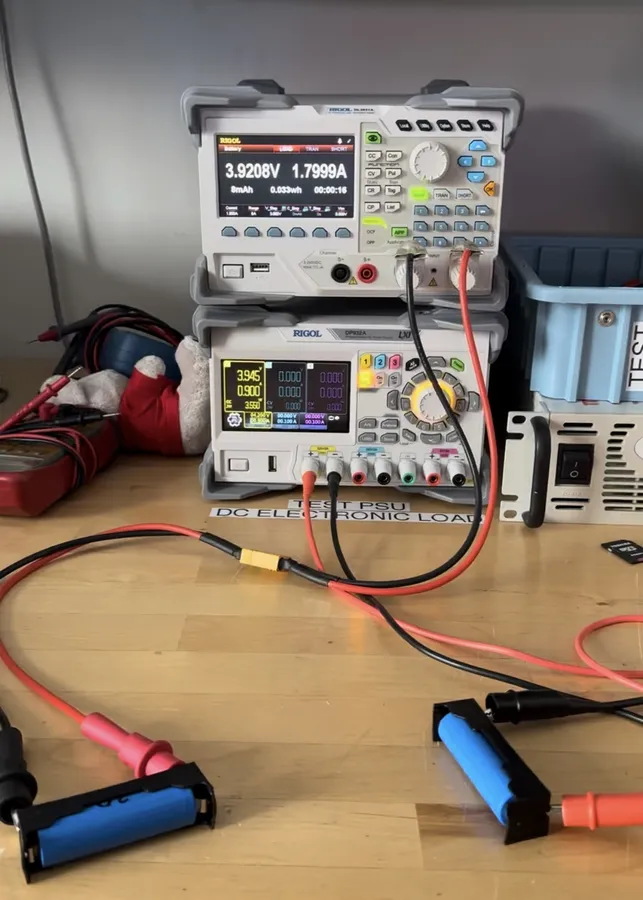
Four cells of each brand, sixteen in total, went through a DeKang DT50W-16 battery tester, which logs voltage and current to within 0.02 V and 0.02 A. Each cell was charged at a constant 1.25 A to 4.2 V, held at 4.2 V until the current tapered to 0.05 A, rested at least five minutes, then discharged at a constant 2.5 A down to 2.5 V. The cells were tested in three batches rather than all at once, as a precaution in case any battery caught on fire.
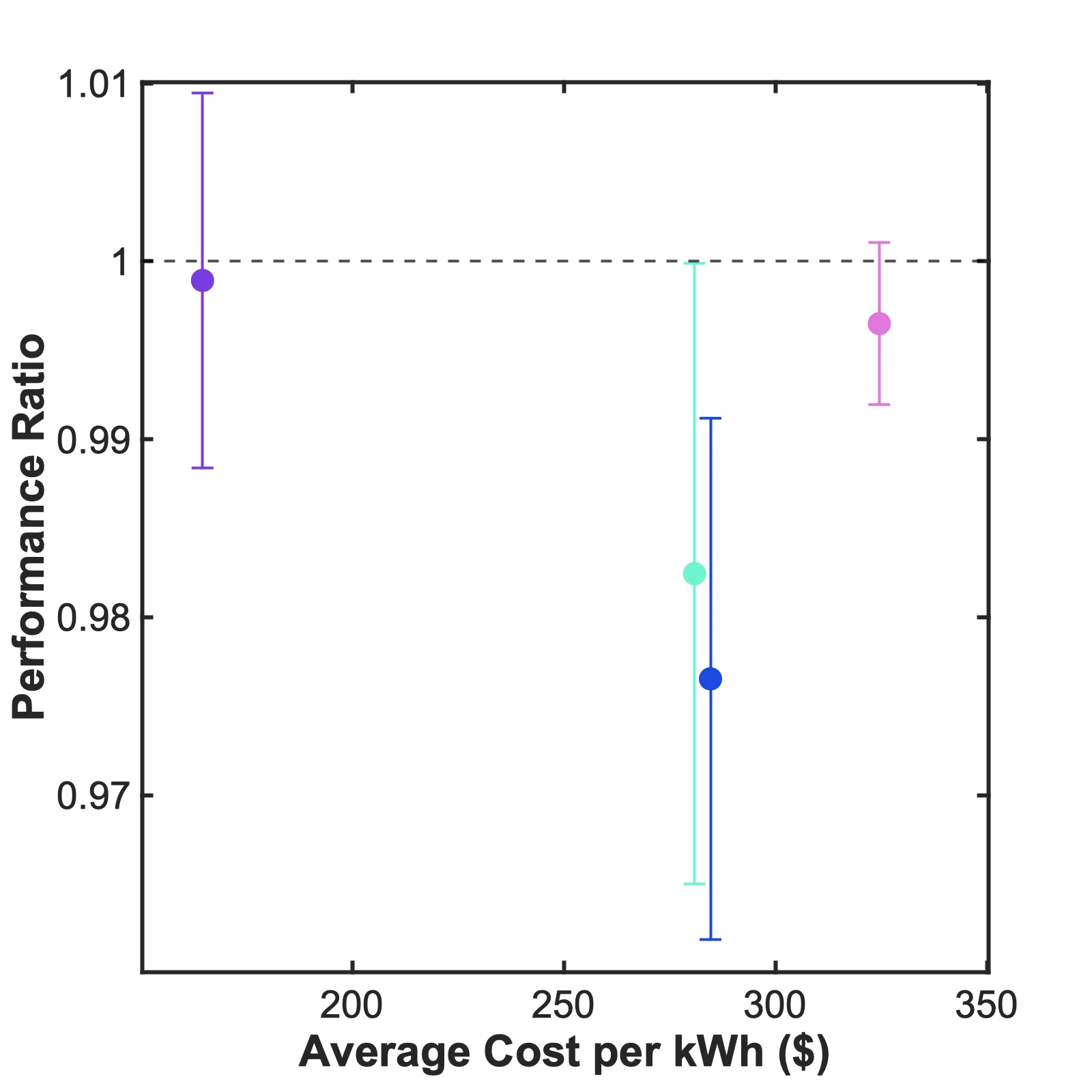
Capacity is the integral of current over the discharge, and energy the integral of current times voltage. The performance ratio divides the capacity measured in the test by the manufacturer's rated capacity, so a ratio of 1 means the cell delivers what it promises.
Batch 2 tried to save time by ending the charge as soon as the cells reached 4.2 V. Skipping that last 30 minutes of charging cost about 0.3 Ah of a 2.6 Ah capacity, so batch 3 went back to the original program to keep the conditions the same.
Results
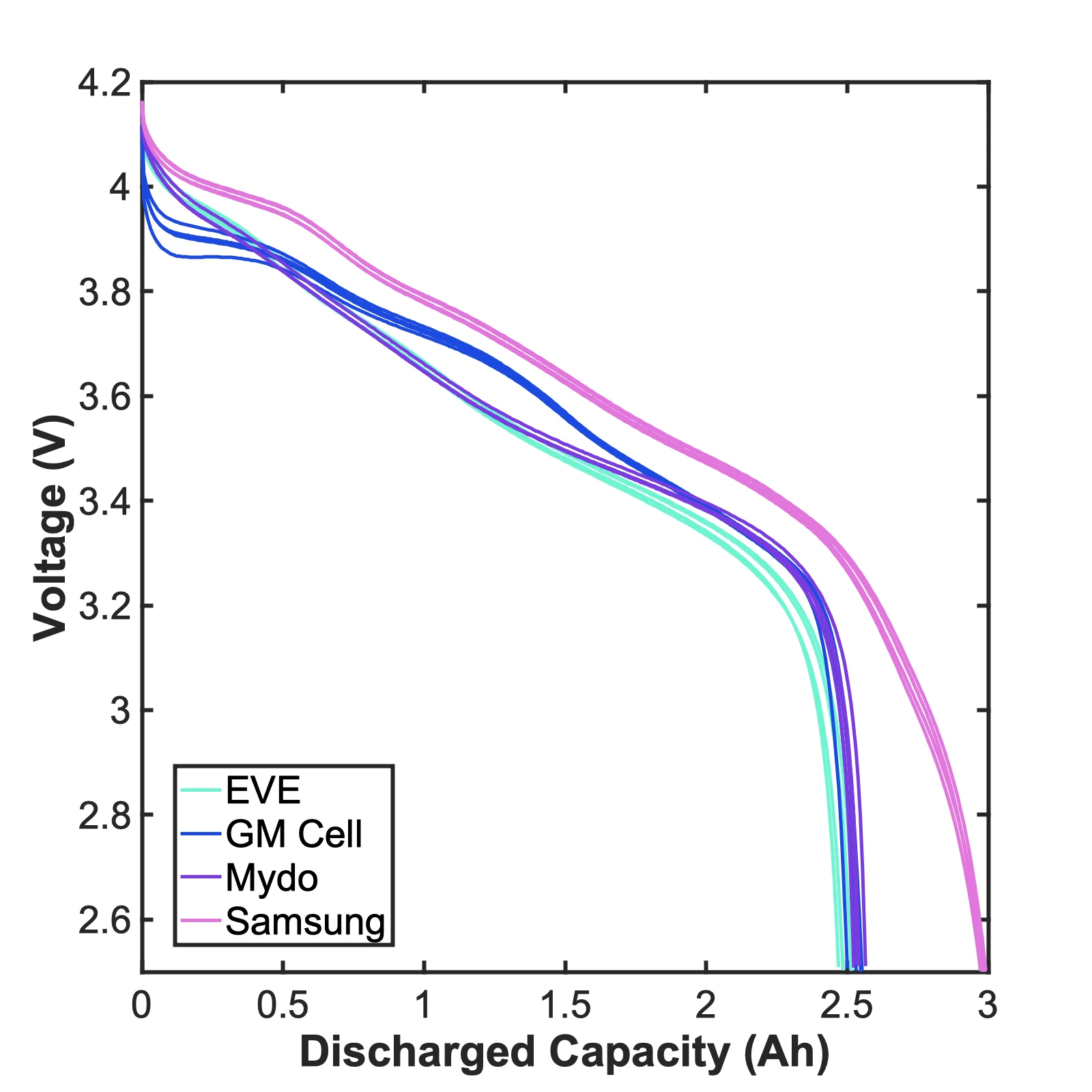
Samsung cells had the highest capacity and the lowest internal resistance; GM Cell had the highest. Each brand's curves were consistent from test to test.
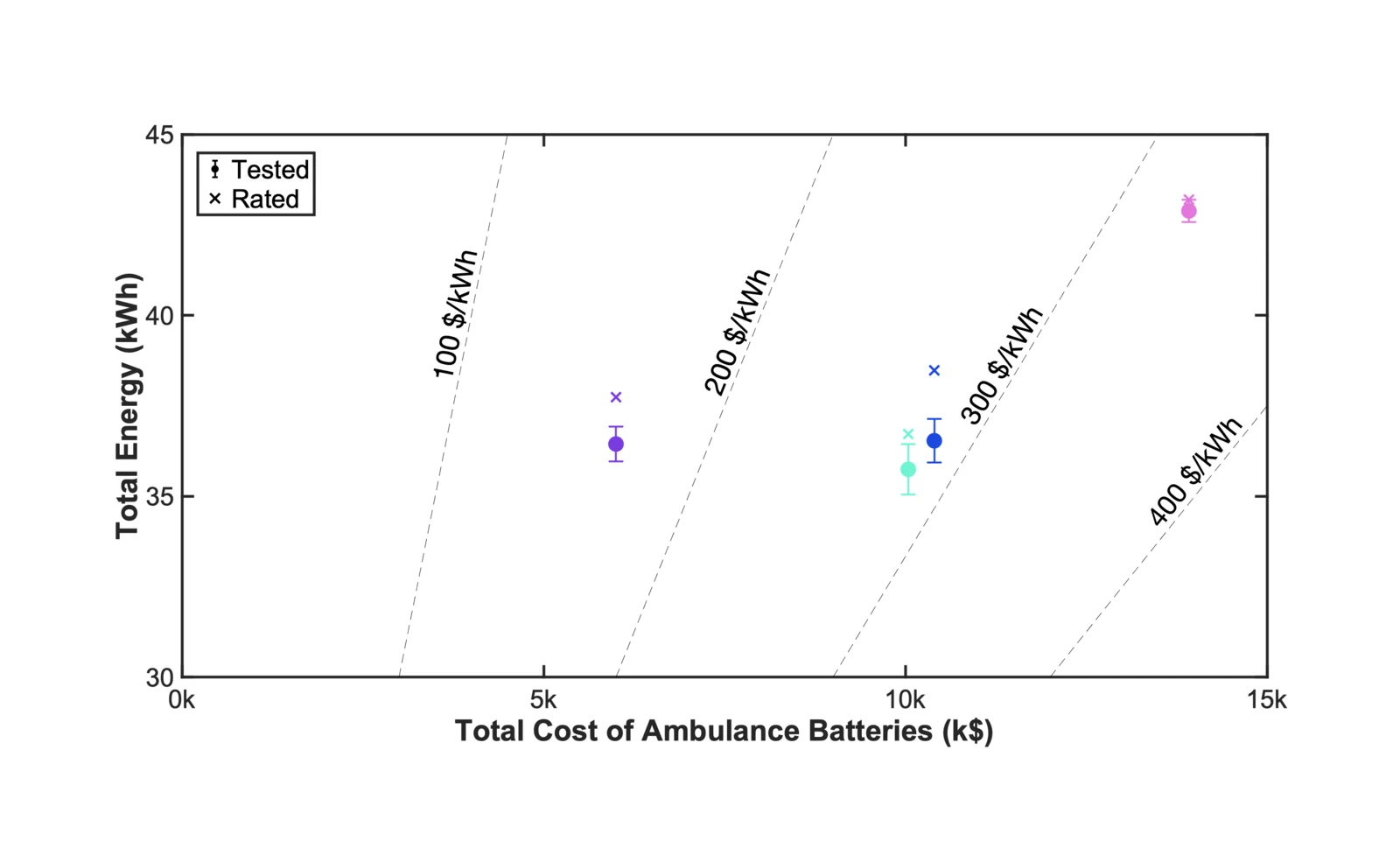
The rated capacities are 2.55 Ah for EVE, 2.6 Ah for GM Cell, 2.55 Ah for Mydo and 3 Ah for Samsung, at bulk costs per cell of $2.51, $1.07, $1.5 and $3.48. Mydo and Samsung came closest to a performance ratio of 1, Samsung marginally ahead with lower uncertainty. EVE and GM Cell had considerably higher uncertainties, suggesting less consistent performance, which may be less suitable for reliable life-saving ambulance trips.
Costed for the four thousand cells the ambulance needs, based on its seasonal operation data, Mydo gives the most energy for the money. Samsung delivers marginally more total energy but does not match Mydo's cost efficiency. Mydo's tested and rated energy only line up at a nominal 3.6 V, which suggests its true nominal voltage may be 3.6 V rather than the 3.7 V published online.
Conclusion
Mydo's cells offer the most advantageous cost-to-energy ratio, which makes them the preferred choice for an off-road electric ambulance in Ghana. Battery costs change, the sample was small and the tester was hard to calibrate, so the next step is following cells over complete life cycles to see how they degrade.
Thanks to Adi Mehrotra, Kevin DiGenova and Dr. Sili Deng for their guidance throughout the experiments and analysis.