Encypher
- Under review at CHI 2027
- MIT Museum
- Performed in MIT's Tull Concert Hall
Shared agency and social presence in collaborative music generation for dance cyphers
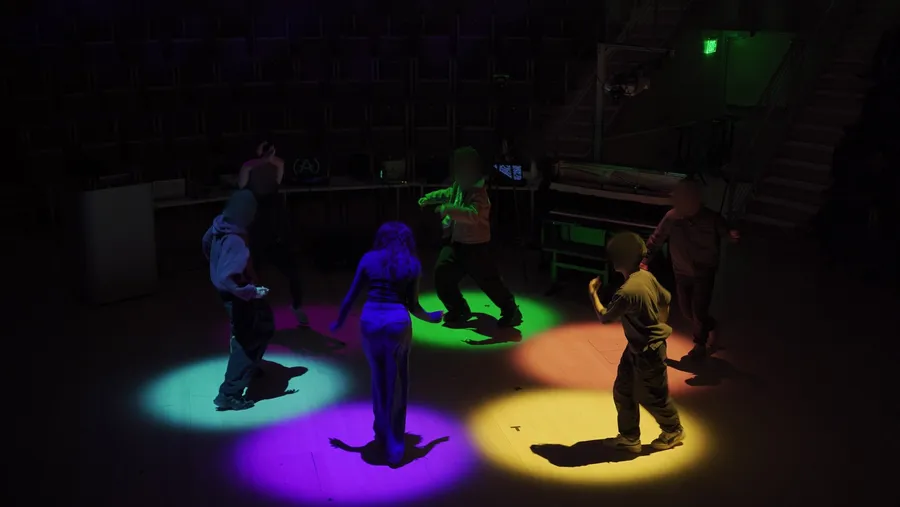
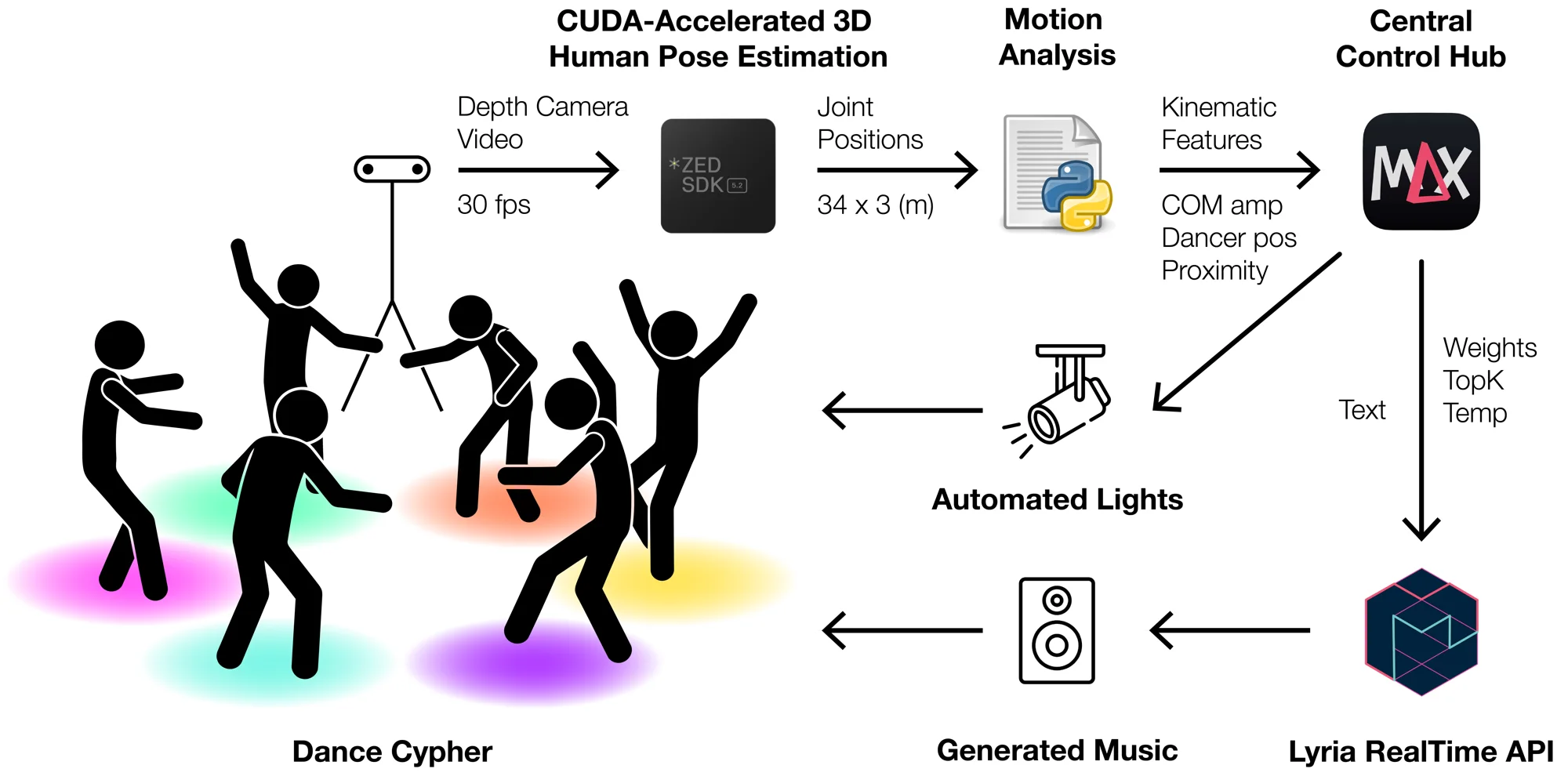
Encypher is a music system for dance cyphers, the Hip-Hop circle where dancers take turns in the center and feed off each other's energy. A camera reads how the whole circle is moving, and a live AI music model plays back what the room is doing, so the music comes from the group instead of a playlist or one person.
I built it for my MIT master's thesis. It started with my own dancing, then five weeks of co-design with a local breaking crew at their open practice, a study with eleven strangers new to dance, a public co-design event at the MIT Museum open to teens and adults, and a screen-free performance for about 300 people in MIT's Thomas Tull Concert Hall.
We the Beat is a series of immersive installations that explore the intersection of music, movement, and technology. At the MIT Museum, Encypher ran as a 65-minute We the Beat session within Design Redefined, a public co-design event on music, AI and community, on April 30, 2026.
Design
I mapped the group's energy and how tightly they hold the circle, not any one person's moves, so no single dancer takes over the sound.
Six zones sit in a circle, each assigned a musical element. How much a dancer grooves on their zone sets the weight of that element's prompt, and the weights add up across everyone, so the energy of the whole group steers the generation. When dancers form a tight cypher, the music becomes more coherent and predictable; when dancers are scattered, the system embraces randomness.
The music model answers in two-second chunks, too slow to feel like a trigger. So we co-designed a charging mechanic: dancers build energy on their zone, and once it reaches a threshold, the music responds.
Co-design
The breaking crew I co-designed with pushed back. Breakers need a steady downbeat to time freezes and power moves, and the AI model could not hold one. Their practice already has its own rituals for who goes next and how the circle responds, and a system that turns dancing to music into playing an instrument takes some of that away from them. So I stopped building it as a tool for that crew and rebuilt it as a way for strangers to start moving together.
Live performance
We performed Encypher live at the MIT Music Technology Research Showcase in Tull Concert Hall on May 13, 2026, in front of an audience of approximately 300.
The screen was removed entirely. Each zone was lit from above by a colored stage light, and each dancer's movement energy drove the intensity of their light, so a dancer charging their zone brightened the pool of light they stood in. Six dancers performed: five members of the local dance community, and me, joining for the final section. Preparation was a single one-hour rehearsal devoted to blocking rather than choreography; within a staggered sequence of entries, all movement was improvised to the improvised music.